Sterility testing is essential in pharmaceutical manufacturing to confirm that sterile products are free from viable microorganisms. Since testing every product unit isn't feasible, a sample is tested from each batch using guidelines from major pharmacopoeias (e.g., USP, EP).
Insourcing vs Outsourcing
When conducting this mandatory process, manufacturers of sterile products have two options. Either they can perform the process in house inside a dedicated sterility testing lab or outsource the process to a third-party testing service.
Insourcing offers better control and can be more cost-effective for large manufacturers.
Outsourcing reduces setup costs but can increase turnaround time, expenses, and risk of product loss due to false positives.
Methods of Sterility Testing
There are two methods for testing the sterility of products - membrane filtration and direct inoculation. Membrane Filtration is by far the most common. The liquid product gets filtered into a canister with growth media to detect the presence of microorganisms.
Direct Inoculation is used when filtration isn't possible. The product is placed directly into a canister with growth media.
With both methods, the cannisters will then be incubated at the appropriate temperature for 14–21 days, which often cause delays in a product release and increase storage costs. Therefore, industry is looking into ways to reduce the waiting time for results.

Diagram showing the two sterility testing methods
The impact of a test failure can also be significant for a pharmaceutical manufacturer as it typically results in regulatory actions, investigations, production halts, drug withholding and additional cleaning/disinfections processes.
False Positives from any kind of contamination is another risk of this process and can result in safe products being discarded unnecessarily.
To reduce the risk of false positives, the sterility testing process should be performed in an aseptic environment.
.png)
Gowned operator performing sterility testing in a laminar air flow hood
Historically, the common approach to achieve this was by performing the process in a biological safety cabinet (BSC) or laminar air flow (LAF) hood. But these traditional environments are still open to potential contamination. Isolators on the other hand can provide a sealed, Grade A environment, and significantly reduce operational costs and false positives.
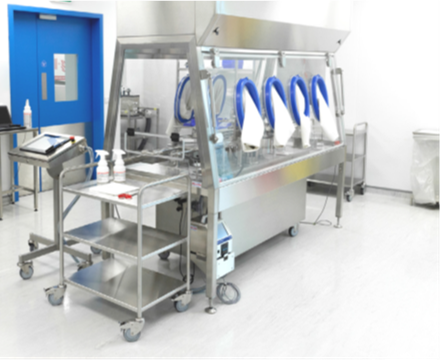
An isolator, as defined by EU GMP Annex 1, is a sealed enclosure designed to maintain Grade A aseptic conditions by ensuring complete separation from the external environment. It undergoes reproducible bio-decontamination and includes features such as:
- Airtight/inflatable door seals and interlocks
- Unidirectional airflow (0.36–0.45 m/s)
- HEPA filters and positive pressure
- Separate leak/pressure testing for enclosure and gloves
- Environmental monitoring and airflow/pressure alarms
- Hydrogen peroxide systems for surface and material decontamination
These elements ensure a sterile internal environment for processes like testing and can result in substantial savings.
One of the biggest hurdles to overcome when switching from a BSC/LAF to an isolator is to maintain the same throughput i.e. number of tests, due to the long bio-decontamination cycle. But this problem can be solved by adopting a modular isolator system, which uses multiple small chambers instead of one large one. While one chamber is used for testing, the next chamber is bio-decontaminated with a small load, allowing cycle times as short as 30 minutes. This setup maintains testing efficiency by enabling continuous operation.

An example of a modular isolator system with a bio-decontamination chamber on the left, testing chamber in the middle, and transfer device on the right
When bio-decontaminating materials prior to conducting a sterility test, it is important to ensure that the hydrogen peroxide does not penetrate through packaging and impact the sample.
The revised EU GMP Annex 1 (Section 10.8) states that decontamination methods must not compromise the test's sensitivity or sample reliability. If HPV enters containers or vials, it could kill microorganisms, potentially causing false-negative results.
To prevent this, testing is needed to prove no HPV remains in product-contact surfaces post-decontamination. This can be done by running de-ionized water through the process and testing it for HPV traces. Ecolab offers this ingress testing using highly sensitive methods (detecting down to 15 ppb) and conducts tests in a controlled setting using a Bioquell Qube isolator.
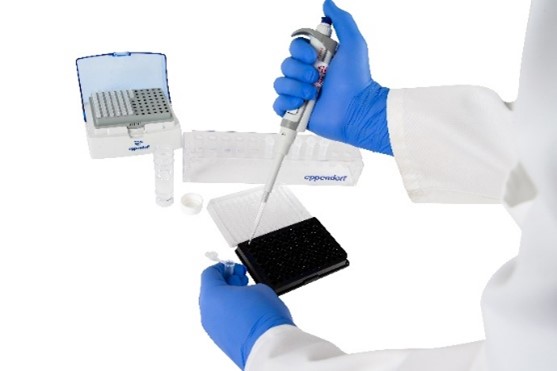
Ingress testing being conducted
The future of sterility testing is shifting toward rapid methods that significantly reduce result wait times, improving operational efficiency and enabling faster patient access to therapies—especially critical for cell therapies with short shelf lives. This trend aligns with EU GMP Annex 1 guidelines, which encourage adopting rapid microbiological methods to reduce contamination risk. Several companies are developing such methods, including technologies like qPCR, ATP-bioluminescence, and CO2-based detection. While some rely on traditional membrane filtration followed by rapid analysis, newer, non-traditional systems are still in earlier development stages.
Conclusion
As has been made clear in this article, sterility testing is a mandatory process to ensure sterile products are free from microorganisms, and if the process is done incorrectly, it can result in unnecessary scrapping of compliant product. Therefore, it is advised to consider the advantages and disadvantages of the various approaches to conduct sterility testing, outlined in the table below.
To read the full article, click here.
To learn more about how the Bioquell Qube can benefit your sterility testing operation, please click here